Dairy Loafing Shed Design Considerations
Are you a dairy farmer? Have you been thinking about ways to improve your milk yield? Have you considered adding a compost-bedded loafing barn? Our article below will cover some things to think about before you start designing & planning your loafing barn.
Why Do You Need A Loafing Shed?
A loafing barn or loafing shed’s primary purpose is to give your cows somewhere that is dry, protected from the elements and has space to lie down. Dairy farmers have told us that loafing barns have improved cleanliness, improved foot & leg health, reduced the instances of infections, and lead to improved milk production. The basic idea is to have happy, comfortable cows.
Why Compost-Bedded?
A composted-bedded loafing area uses a deep layer of dry bedding material (usually sawdust, but more on that later) in a covered shed. The shed itself is generally one undivided open space. The composting process allows the bedding material to stay dry, reduces smell, and is easier to maintain.
The composting process
The dry bedding absorbs the cow manure and urine, and with the right conditions, begins to compost. Composting is essentially the bedding material and animal waste being broken down by a variety of microbes. For composting to happen effectively, the bedding material needs to contain the right proportions of carbon-rich (like sawdust) and nitrogen-rich (like manure or urine) materials. The third thing the composting microbes need to break down the materials is oxygen. Oxygen is incorporated by stirring the compost bedding pack at least twice a day.
Composting will increase the temperature of the bedding, and decrease the moisture by accelerating the rate of drying.
Benefits over other options
Compost bedded loafing sheds have advantages over other materials.
- Drier, more protected and longer-lasting than grassed areas
- More comfortable for cattle than concrete floors
- The bioactive composting bedding produces fewer odours and fewer flies
- The bedding lasts longer, with less maintenance than other surfaces
- The composted material can be finished after cleanout to create a value-added product
Why sawdust is the optimal material
Sawdust is the preferred material for the bedding base as it has high amounts of carbon to ensure the composting microbes have the energy they require while providing a comfortable surface for the cattle. Fine sawdust is also highly absorbent. Some dairy farmers choose to use other materials, including sugarcane bagasse. The critical factors in selecting the right bedding material are ensuring it has sufficient absorbency, ensuring it provides a comfortable surface that is unlikely to injure cows, ensuring it will be able to give an appropriate carbon to nitrogen ratio, and ensuring that it is readily available in large quantities to add to the loafing barn as required.
Shed Design Factors
Site
There are a few essential requirements to consider when selecting a site for your compost-bedded loafing shed. Firstly, you should ensure there is enough space between the new loafing shed and any existing structures that may block airflow. Building too close to existing sheds, silos, or other obstructions could affect the amount of moisture and heat that can be removed from the loafing area.
An ideal site should also be elevated slightly to allow for the diversion of any rain away from the bedding area and be in a position which minimises the environmental risk of any potential seepage from the compost base.
The base underneath your compost pack is also an important consideration. Gravel or road base are both practical (and generally cost-effective) bases, but concrete is also an option. Concrete has no advantages as a base in a compost-bedded loafing barn, so if your local regulations allow you to use a gravel base that is likely the best choice.
Orientation
Most dairy farmers have had the most success orienting their loafing barns east-west rather than north-south. An east-west orientation will help you to take advantage of the prevailing winds and avoid late afternoon sun shining in your barn and heating it beyond comfortable temperatures for your herd.
Size & Height
The size of your loafing barn is going to depend on the size of your herd. The barn cannot be overstocked to ensure the compost pack remains healthy and dry. To estimate the size you’ll need, it’s a good idea to allow for a 13-metre square area per cow. This would mean for a comfortable barn for 200 cows, you’ll need 2600 metres square floor area, or a 26 x 100 m shed.
In terms of height, having the largest sidewall opening possible (the space between the ground or retaining wall and the eaves) will assist in providing enough ventilation. As a minimum, you’ll likely need a 3.6m sidewall opening, increasing to 4m if your loafing shed has a width of more than 12m. When calculating your sidewall opening height, be sure to factor in the height of any retaining walls required to keep the bedding in place. Our experts can advise on the best shed height for your specific requirements.
Ventilation
Ventilation is vital to keep the temperature comfortable, the compost composting, and the cows happy. You need good airflow, consistently delivering fresh oxygen into your shed. Proper ventilation can be achieved by using ridge vents, large ventilation fans, and a design and location that maximises natural ventilation.
Keep in mind though, that too much ventilation can cause difficulties in controlling the temperature, and make it difficult to keep the shed comfortably warm for your cows.

Ridge Vents
A ridge vent is an opening located along the central ridge of your shed. Ridge vents help with ventilation by creating a convection effect. Hot air rises and exits through the vent, which in turn pulls in more fresh, cooler air from the sidewall openings. The pitch of your roof is also essential to ensure the effectiveness of a ridge vent. Not steep enough, and there won’t be a significant enough difference between the hot and cold air to create a convection effect.
For sufficient heat dispersal, we recommend a minimum of a 75mm ridge opening for every three metres of width, and a minimum 300mm opening for loafing sheds less than 12m wide. For example, a 30m wide shed would need a 750mm wide vent (10 x 75mm = 750mm).
Our design consultants can help you determine a suitable roof pitch and ridge vent width depending on the size, location, wind rating region and other factors.
Fans
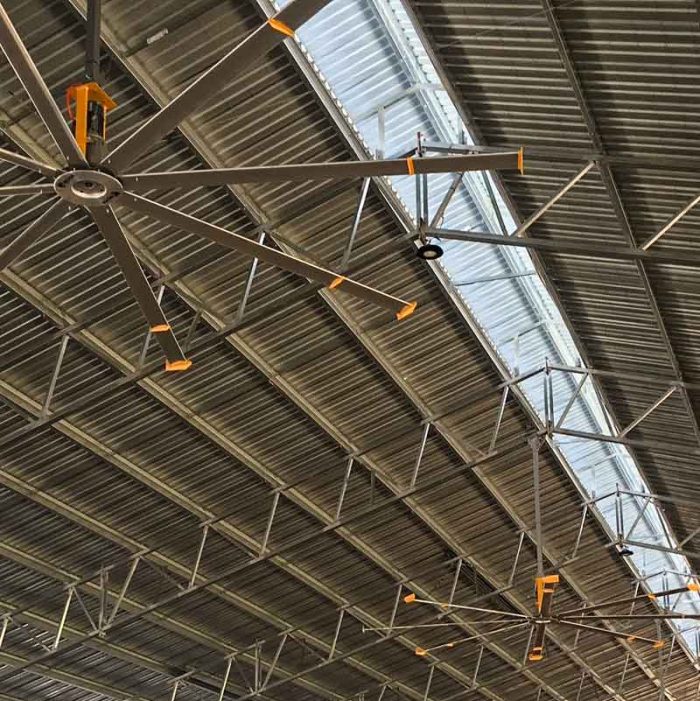
Fans can assist with keeping air circulating inside your loafing barn and keeping your compost pack dry. They can also help with keeping the temperature inside comfortable, allowing for a more even distribution of cows throughout the loafing area, and reducing the risk of manure and urine buildups in particular areas which can slow the composting process.
Many dairy farmers choose to use high-volume, low-speed ceiling fans, but box-fans are also an option. Whatever fans you choose, it’s crucial to ensure they are positioned well within the structure, and allow enough space for equipment to turn over the compost pack at its maximum depth.
Design Factors
Other design factors will influence the amount of natural ventilation the loafing barn gets. Roof height, roof angle, prevailing wind direction and wind speeds in your region will all determine how much additional mechanical ventilation your loafing barn will need to keep the moisture and oxygen levels in ideal ranges.
Materials
The materials you select for building the loafing barn structure will depend on your budget, location, and other specific requirements.
Our expert design consultants do recommend ensuring that the columns of your structure are hot-dip galvanised structural steel to ensure longevity in the wet and corrosive conditions.
Other Important Considerations
You also need to ensure you have a way to keep the compost bedding in the shed. This is generally achieved with a retaining wall, higher than you require the depth of the bedding. 800mm is typically sufficient to provide a 300mm bedding depth.
You should also consider how you will incorporate the structure with laneways, feed and water areas, and your existing infrastructure.
Our Innovative Loafing Barn Solutions
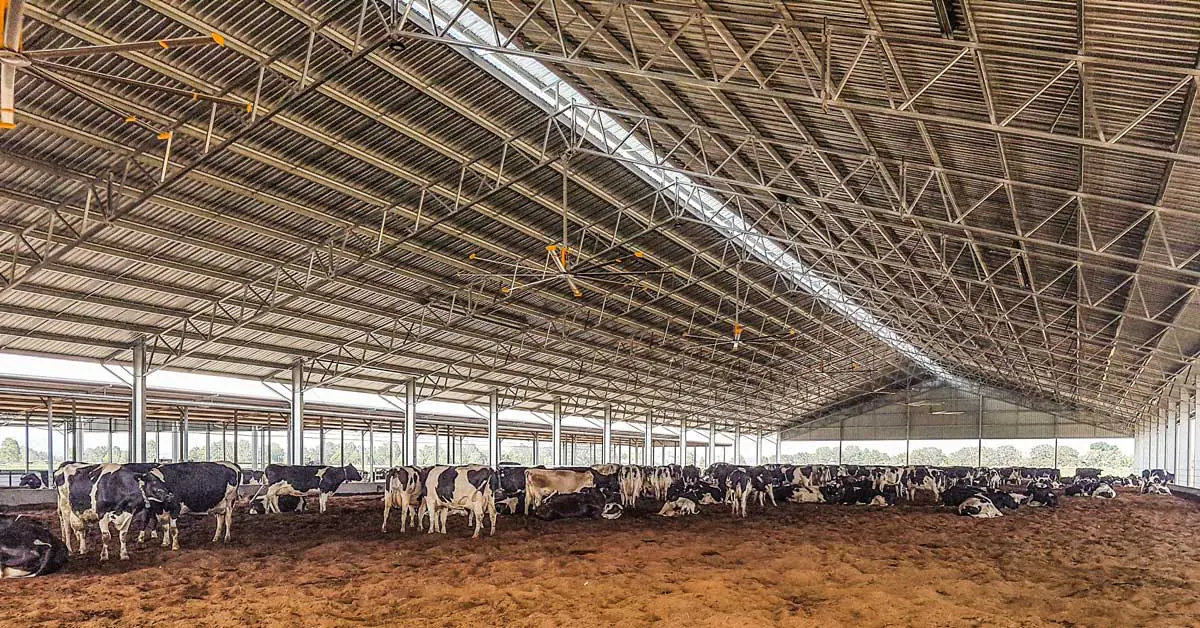
Are you looking to increase the milk yield from your herd? Read our case study for a loafing barn we constructed in Singleton, NSW. In this case study, our customer came to us with a well-established design brief for their dairy shed. There were several challenges unique to this project that we thoroughly considered. Find out how we were able to overcome these challenges and help the end-user gain an estimated 20% increase in milk yield.